Understanding watch specifications can save you time, money, and frustration. Whether you’re buying your first everyday carry watch or expanding your collection, knowing how to read watch specs helps you compare features and make the right choice for your needs.
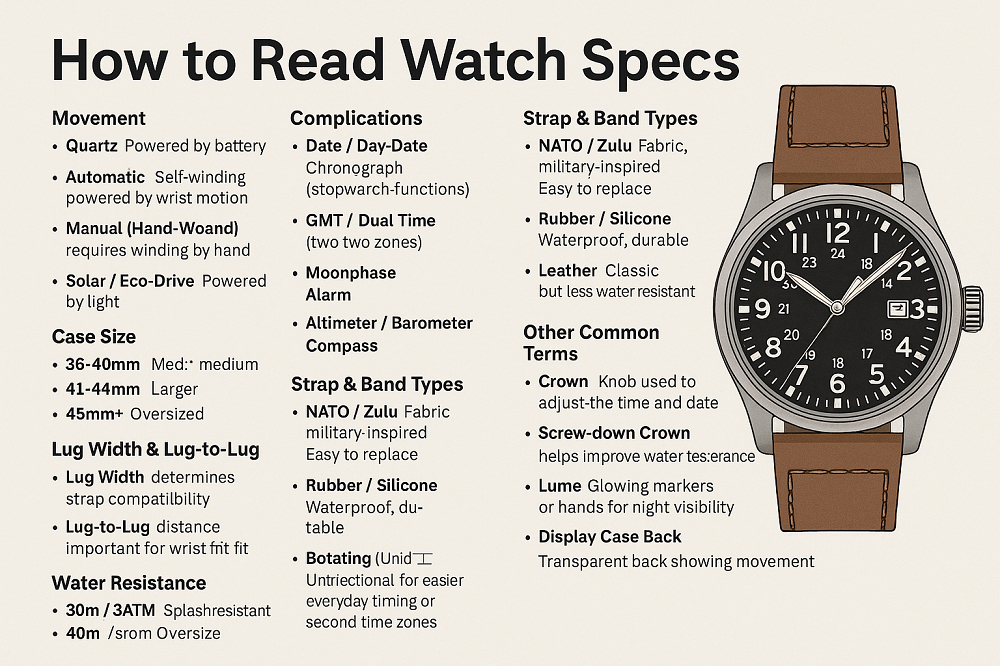
This guide breaks down the most common watch terms and what they actually mean.
Movement
Quartz
Powered by a battery. Known for accuracy and low maintenance. Ideal for users who want “set it and forget it” timekeeping.
Automatic
Self-winding mechanical movement powered by wrist motion. Requires occasional wear or winding. Known for craftsmanship and longevity.
Manual (Hand-Wound)
Mechanical movement that requires winding by hand. Often used in vintage or enthusiast watches.
Solar / Eco-Drive
Powered by light. No need to replace batteries. Reliable for long-term use and minimal maintenance.
Case Size
Measured in millimeters (mm), typically across the diameter without the crown.
- 36–40mm – Medium, suitable for most wrists
- 41–44mm – Larger, bolder presence
- 45mm+ – Oversized or tactical style
Case Thickness is also listed in mm and affects comfort, especially under sleeves.
Lug Width & Lug-to-Lug
Lug Width determines strap compatibility (e.g., 20mm strap for a 20mm lug width).
Lug-to-Lug Distance is the total length from one end of the case to the other, important for wrist fit.
Water Resistance
Usually listed in meters (m) or ATM (atmospheres):
- 30m / 3ATM – Splash resistant
- 50m / 5ATM – Shower or rain safe
- 100m / 10ATM – Swimming and light snorkeling
- 200m / 20ATM – Diving and heavy water use
- Diver’s 200m+ – ISO-certified dive standards
Note: These ratings assume static pressure. Water resistance decreases with age and wear.
Crystal
The transparent cover over the dial.
- Mineral – Scratch-resistant, budget-friendly
- Acrylic – Soft, can scratch easily but is easy to polish
- Sapphire – Extremely scratch-resistant, found on higher-end watches
Bezel
The ring surrounding the crystal.
- Fixed – Purely decorative or protective
- Rotating – Used for timing, diving, or dual-time functions
- Unidirectional – Safer for dive use (won’t overestimate time left)
- Bidirectional – Easier for everyday timing or second time zones
Complications
Extra functions beyond telling time:
- Date / Day-Date
- Chronograph (stopwatch functions)
- GMT / Dual Time (two time zones)
- Moonphase
- Alarm
- Altimeter / Barometer / Compass (on some digital or smartwatches)
Strap & Band Types
- NATO / Zulu – Fabric, military-inspired, easy to replace
- Rubber / Silicone – Waterproof, durable
- Leather – Classic, but less water resistant
- Bracelet – Stainless steel or titanium with adjustable links
Band specs usually include width, material, and length.
Battery Life / Power Reserve
- Quartz / Smartwatches – Listed in months or days
- Automatic / Manual – Listed in hours of power reserve (e.g., 40–80 hrs)
Solar and automatic watches may charge continuously depending on use or light exposure.
Other Common Terms
- Crown – The knob used to adjust the time and date
- Screw-down Crown – Helps improve water resistance
- Lume – Glowing markers or hands for night visibility
- Display Case Back – Transparent back showing movement (often on automatics)
Understanding these terms helps you focus on what matters most: choosing a watch that fits your lifestyle, budget, and expectations.